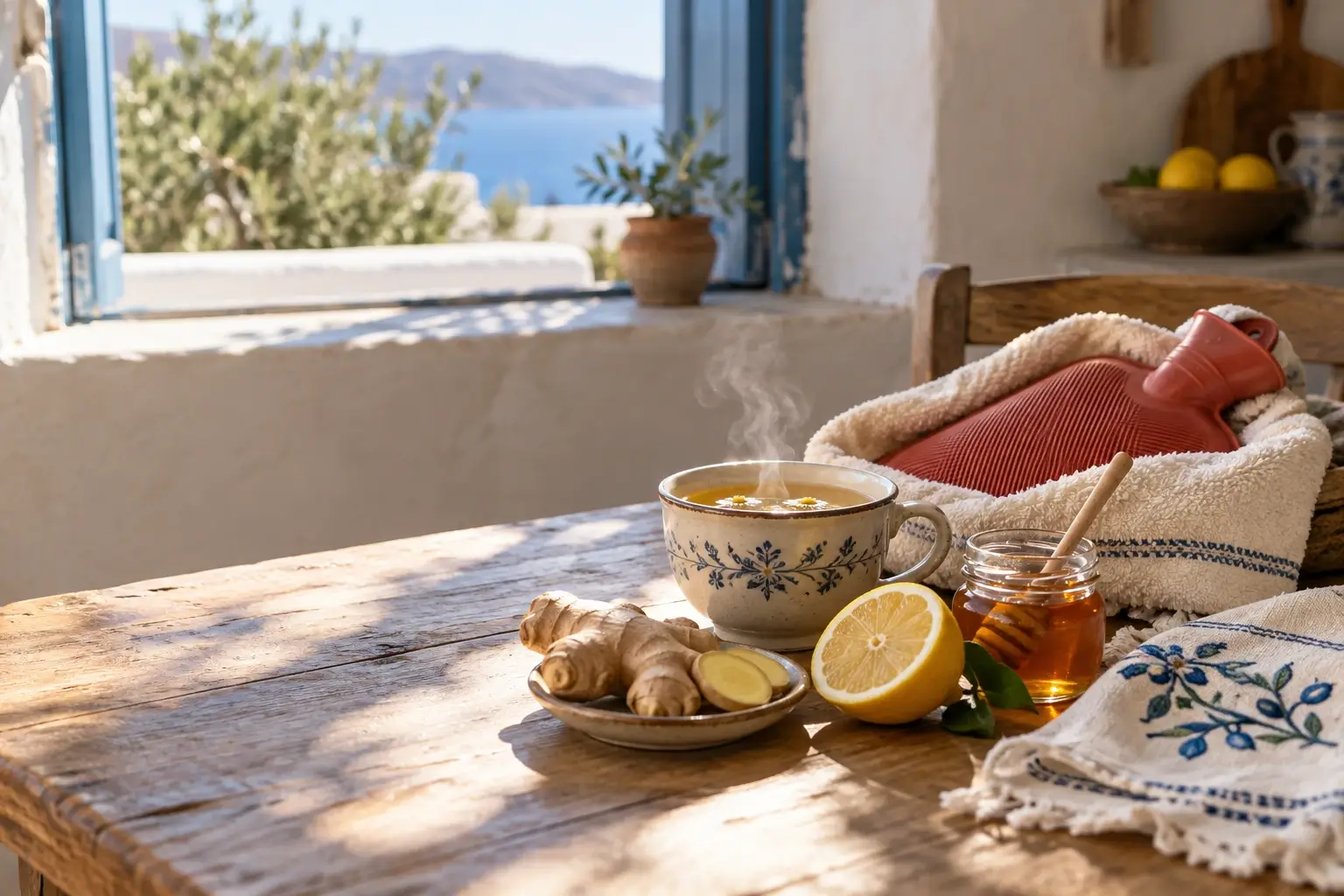
Socks, χαμομήλι, something warm to eat and a deeply personal family vendetta against cold marble.
There are certain things a Greek girl learns without anyone officially teaching her.
Never leave the house with wet hair. Never sit on cold marble. A little lemon fixes many things. And if something hurts, there is almost certainly a tea for it.
Periods are no exception.
Long before heating pads, period-tracking apps and ibuprofen, Greek mothers and yiayias had their own system: warmth, tea, food, unsolicited theories about what caused the pain and enough concern to make your period a family affair.
Not every Greek household is the same, of course. Some of these are old folk remedies, some are simply things mothers do, and some may have been passed down in your family completely differently.
But if you’ve ever said «πονάει η κοιλιά μου» and immediately been handed a pair of socks and a cup of χαμομήλι, this one is for you.
♡
1. Put socks on. Immediately.
You could be doubled over with cramps and somehow a Greek mother will identify the real problem:
Your feet are cold.
«Βάλε κάλτσες, παιδί μου.»
Walking barefoot on cold tile? Sitting on the marble? Leaving your lower back uncovered?
According to the unofficial Greek Mother Medical Association™, all highly suspicious activities.
Does being barefoot actually cause menstrual cramps? No.
Are we putting the socks on anyway?
OBVIOUSLY.
♡
2. And whatever you do, DO NOT sit on the cold floor
This deserves its own section because Greek mothers have been fighting cold surfaces for generations.
Cold tile. Cold concrete. Marble steps. That suspiciously chilly chair outside the kafeneio.
«Μη κάθεσαι κάτω, θα κρυώσεις.»
What exactly will happen to you after sitting there is sometimes unclear. But based on the urgency with which you’ve been removed from cold surfaces since childhood, nothing good.
During your period, this warning somehow becomes even more serious.
The modern koukla verdict: the floor didn’t give you your cramps. But being warm when you’re already uncomfortable?
We’ll allow it.
♡
3. Θερμοφόρα. No discussion.
Now we’re getting to something both generations can agree on.
If your family owns a θερμοφόρα—a hot-water bottle—you already know the routine.
Fill it. Wrap it in a towel. Put it on your lower stomach. Remain there until further notice.
And for once, yiayia was onto something.
Heat really can help with period cramps. So whether you’re using the old-school red rubber bottle that’s somehow been in the house since 1987, a fancy electric heating pad or even a steaming hot bath, this tradition can stay.
Just don’t make it painfully hot or fall asleep directly on intense heat.Yiayia wants you warm. Not medium-rare.
♡
4. Χαμομήλι, because of course
Chamomile is the official Greek beverage of:
Something is wrong, but we are not panicking yet!
Stomach hurts?
Χαμομήλι.
Can’t sleep?
Χαμομήλι.
Feeling anxious?
Χαμομήλι.
Crying over a man your mother told you she didn’t like six months ago?
Put some honey in it.
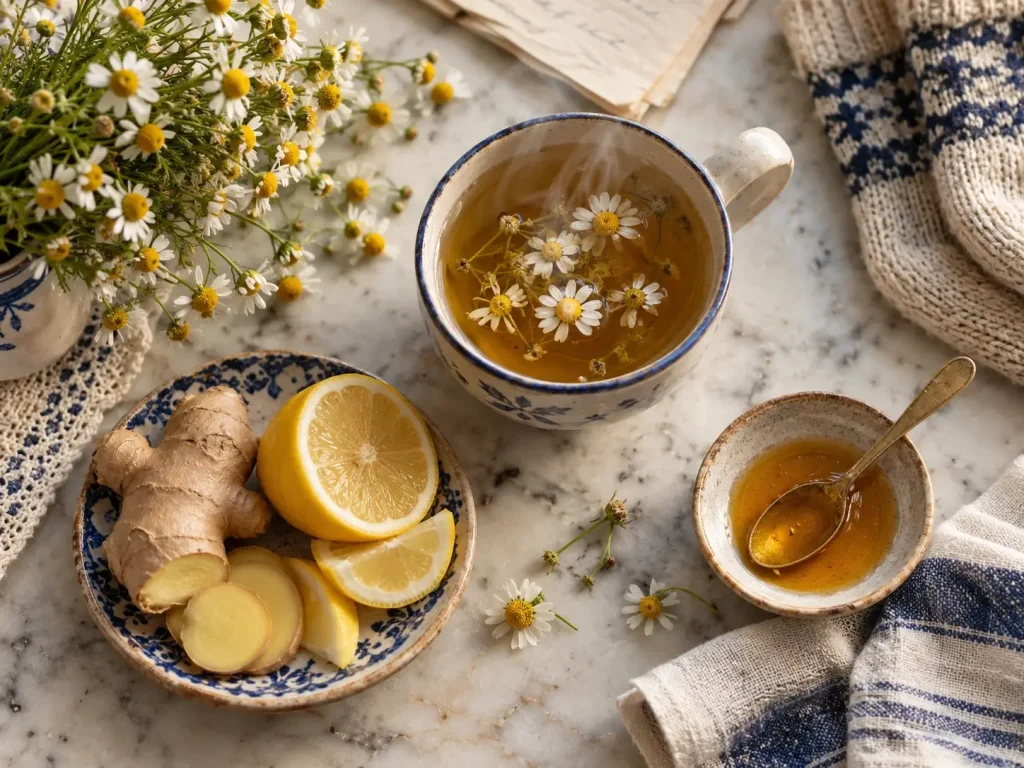
So naturally, when period cramps arrive, the kettle comes out.
Chamomile has a long history in traditional herbal use, including in Greece. Whether or not your cup magically fixes your cramps, there is something undeniably comforting about being handed warm tea when you feel horrible.
And sometimes comfort gets to be enough.
♡
5. Or your family has that one herb
This is where things get interesting.
Ask five Greek yiayias for a home remedy and you may leave with seven different plants.
Depending on the family and region, you might hear about μαντζουράνα (marjoram), φασκόμηλο, mountain herbs or some mysterious dried plant stored in an unlabelled glass jar that yiayia somehow identifies on sight.
And μαντζουράνα isn’t something we just made up for the aesthetic. Researchers interviewing people around Edessa, Naoussa and nearby villages in Central Macedonia actually documented the traditional use of marjoram decoction for menstrual pain.
Which means somewhere along the family tree, «πιες μια μαντζουράνα» really was the prescription.
That doesn’t mean every traditional herb is proven to treat cramps—or that herbs can’t interact with medications—but the tradition itself is very real.
And we kind of love that.
♡
6. You need to eat something
There are few things more offensive to a Greek mother than discovering you have not eaten.
Now add period cramps.
«Μα δεν έφαγες τίποτα σήμερα!»
Suddenly your empty stomach is under investigation- especially when the menstrual bleeding starts.
Maybe it’s soup. Maybe τραχανάς. Maybe toast. Maybe rice or potatoes. Maybe αυγολέμονο. Maybe whatever happens to be cooking that day because your mother does not recognize your claim that you’re “not hungry” as legally binding.
There is no magical Greek food that makes a period disappear. But, remaining on an empty stomach while bleeding is a big NO NO !
But if you’ve been surviving on one freddo espresso and hormonal mood changes since 10 a.m., eating an actual meal and drinking some water probably isn’t the worst suggestion your mother has ever made.
And if the only thing you want is the crispy corner piece of spanakopita?
This is not the day for moral philosophy.
Eat the spanakopita.
♡
7. Cover your stomach. And your back. Actually, just cover everything.
A crop top during your period?
Bold of you.
Greek mothers have a longstanding concern with the μέση—your lower back/waist area—being exposed to cold air.
You may therefore find yourself being instructed to tuck in your shirt, put something around your waist or generally stop dressing like it’s August when it’s technically 21°C outside.
And please tell us this isn’t just our family: have you ever gone to hug your mother, yiayia or theia only for her to physically pull your shirt down over your lower back mid-hug?
No warning. No explanation. Just tug.
«Σκέπασε τη μέση σου.»
Apparently, affection can wait. Your exposed μέση is an emergency.
Will covering your lower back alter your menstrual cycle?
No.
Does being bundled up like somebody’s παππού sometimes feel surprisingly nice when you’re cramping?
Unfortunately, mama may have a point there.

♡
8. Lie down — but prepare to be checked on every six minutes
Once it has been established that you are genuinely suffering, Greek-mother protocol enters its final stage:
«Πήγαινε να ξαπλώσεις.»
So you lie down.
Three minutes later:
«Είσαι καλύτερα;»
Then someone brings you tea.
Then fruit.
Then asks if you want food.
Then comes back because you didn’t eat the fruit.
Then another relative somehow learns you’re not feeling well.
Resting in a Greek household is rarely a solitary activity.
But when cramps are exhausting you, taking it easy isn’t laziness. Cancel something. Take the nap. Get under the blanket.
Just accept that somebody may open the door every few minutes to make sure you’re still alive.
♡
9. And then there’s the advice nobody can actually explain
Every family has one.
A remedy. A warning. A rule.
Something your mother learned from her mother, who learned it from hers, and nobody currently involved can provide a satisfactory explanation for why we’re doing it.
Maybe you’re not supposed to wash your hair.
Maybe there’s a specific tea.
Maybe you’re supposed to eat something particular.
Maybe your yiayia is absolutely convinced that something you did three days ago is the reason your period hurts today.
Do we have scientific documentation for all of this?
Absolutely not.
Do we want to hear every single one?
Absolutely yes.
Because these little pieces of advice are part of something bigger: the strange, funny and incredibly specific ways women pass knowledge—and care—down to each other.
Even when that knowledge occasionally involves a personal vendetta against ceramic flooring.
♡
Okay, but what actually helps period cramps?
We love yiayia. We also love evidence.
Heat is one of the traditional remedies worth keeping. Gentle movement can help some women too, and anti-inflammatory pain medicines such as ibuprofen or naproxen are commonly used for menstrual cramps because they reduce prostaglandins, chemicals involved in uterine contractions.
Those medicines aren’t appropriate for everyone, so follow the label and check with a pharmacist or doctor if you have medical conditions, take other medications or aren’t sure what’s safe for you.
And while tea, blankets and having your mother force-feed you toast can make a miserable day nicer, severe period pain shouldn’t automatically be dismissed as «έτσι είναι η περίοδος.»
If your cramps regularly stop you from working, studying, sleeping or living normally—or they’re becoming significantly worse—talk to a healthcare professional. The same goes for unusually heavy bleeding or symptoms such as significant pain during sex, urination or bowel movements.
Sometimes period pain needs more than χαμομήλι.
♡
Maybe yiayia’s real remedy was being looked after
Maybe that’s the part worth keeping.
The tea may vary. The herb may change from one village to another. Mama’s theory about the cold floor may be medically questionable.
But underneath all of it is a very Greek form of love:
Have you eaten?
Are you warm?
Does it still hurt?
Do you want me to make you something?
Sometimes aggressively.
Sometimes while criticizing your lack of socks.
But lovingly nonetheless.
So make the χαμομήλι. Get the θερμοφόρα. Put on the socks you were repeatedly told to put on twenty minutes ago.
And then call your mother and ask her what her mother used to do.
You might be surprised by the answer.
Now we want to know: what did your Greek mother or yiayia swear by when you had your period? Tell us your family's remedy—especially the weird ones.
♥